Qlro (/'klɛroʊ/) — Quantum Logic Routing
Tell us your workload.
We show where to run it first.
Benchmark-grounded fit, propagated uncertainty, and an audit-ready decision record — for the workload you actually run, on the snapshot you can cite. Powered by Metriq benchmark data.
49 procurement-ready templates across pharma, finance, manufacturing — plus a daily operations dashboard that tracks every device in one place.
●LLM-free scoring. Devices are ranked by deterministic math on benchmark data, not by language-model judgment.
Virtual screening against a target library — what most pharma teams try first on quantum hardware.
Knock-in / knock-out exotic pricing — the canonical Monte-Carlo workload sell-side desks port to quantum.
Multi-machine throughput optimisation — production-realistic constraint problem that QAOA-style solvers tackle.
Install the SDK and score your circuit against every device in 15 seconds.
$ pip install qlroInstallOr try the in-browser demoWCPP is published with a permanent DOI under CC BY 4.0 — ready for academic citation and RFP references.
doi.org/10.5281/zenodo.19785800ReadOr copy the BibTeXIf you have to justify a quantum-vendor decision to a CTO, an audit committee, or a government RFP, the artefact you need is a content-hashed decision record with snapshot provenance and bilingual PDFs. That is the surface Qlro is built around.
audit-anatomy walkthroughInspectPick a workload, mint a record




From circuit to citable decision in 15 seconds
Three stages. Vendor-neutral at each one. Reproducible end-to-end.
What you hand to procurement
Every recommendation exports as a signed decision record — top pick, runner-up, reasoning, the Metriq commit it was scored against, and a permanent citation URL. Audit-ready by default.
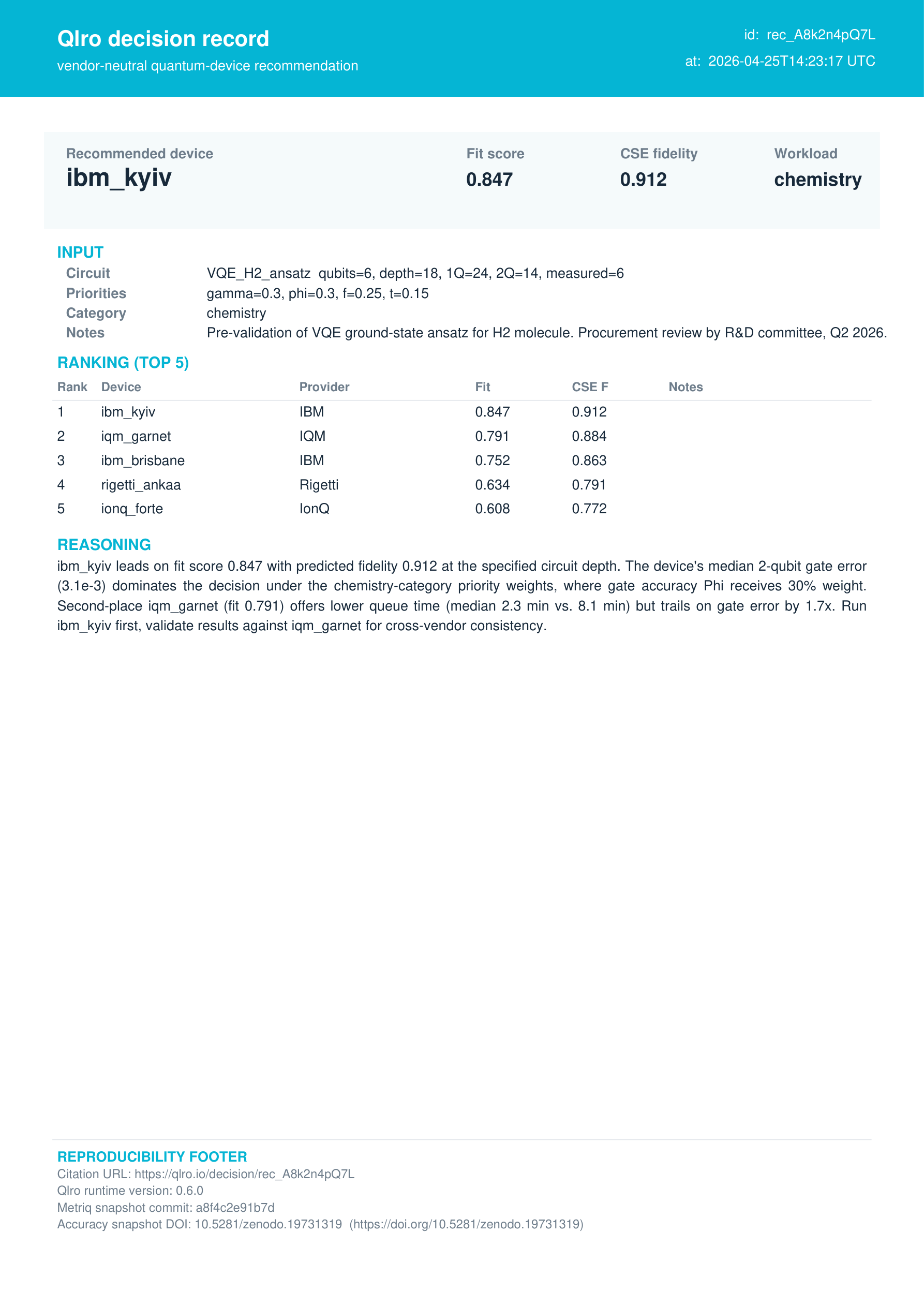
Not just a ranking — the second-best alternative is always spelled out, so you know the tradeoff you're making.
Why this device won on this workload. What was observed, what was estimated, what was assumed — never blurred together.
The exact benchmark snapshot the decision was scored against. Anyone — auditor, reviewer, competitor — can reproduce it byte-for-byte.
Paste it into a paper, an RFP, a board deck. The record is frozen at the moment of export — even if the ranking shifts next week.
Independent validation
We reproduce vendor claims — from their competitors' data.
Three quantum hardware vendors publish performance claims. WCPP derives those same numbers from Unitary Foundation's Metriq benchmarks — without ever touching vendor calibration data.
Their own press release. Our WIT transform derives it from independent Metriq data. Agreement to four decimal places, zero tuning.
0.43 percentage-point gap, in the direction physics predicts — isolated-gate claims always beat layered-circuit measurements.
IBM's own narrative: newer Heron R2 beats R1. WCPP agrees on chemistry, optimization, and ML. Simulation flips — within uncertainty.
How it works
Four axes. One workload-conditioned score.
WCPP (Workload-Conditioned Physical Projection) scores every quantum device on four capability axes, then composes them with workload-specific weights.
Verified entanglement coverage across the chip.
Information survival over circuit depth.
Per-operation accuracy.
Effective operations per second.
Qiskit QuantumCircuit or OpenQASM string. Plus the workload type.
Four axes × workload weights → a single comparable score with uncertainty bands.
Every ranking is tagged with the Metriq commit hash — anyone can reproduce it.
Cite this work
The WCPP framework is published with a permanent DOI under CC BY 4.0.
@misc{oh2026wcpp,
  author    = {Oh, Yeonwoo},
  title     = {{Workload-Conditioned Physical Projection: A Vendor-Neutral Framework for Quantum Device Selection}},
  year      = {2026},
  publisher = {Zenodo},
  version   = {1.2},
  doi       = {10.5281/zenodo.19785800},
  url       = {https://doi.org/10.5281/zenodo.19785800}
}Ready to use it?
Install the library, or try the interactive demo in your browser.